Procedure
- Observe the LED indicators
and digital status display to the right of the CB1
main line switch on
the rear of both DSUs.
Use Table 1 to find the condition that applies:
Table 1. LED indicators when CB1 main line switch is on and UEPO switch is off LOCAL AC (input)  Figure 1
DSU Service  Figure 1
Digital Status Display  Figure 1
Action Off Off Off Normal UEPO condition, continue with the next step. On Ignore Ignore UEPO failing, go to MAP21F1 DC-UPS should be off when UEPO switch is off. Figure 1. LEDs on the DC-UPS DC Supply Unit (DSU), rear of rack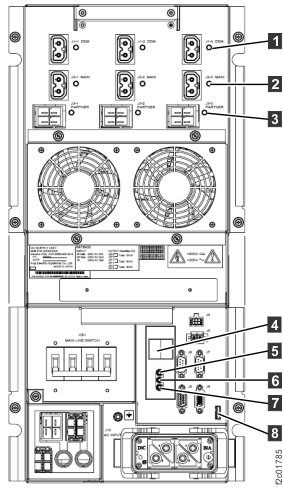
- Use Table 2 to
find the condition that applies. Note: Other LED indicators may be on or flashing ("J1-1 DDM", for example). For this step, we are concerned only with the LOCAL AC and DSU SERVICE LEDs and the digital status display.
Table 2. LED indicators when UEPO switch is on LOCAL AC (input) Figure 1DSU Service Figure 1Digital Status Display Figure 1Action On Off Blank Normal condition, continue with the next step. On Off Two-character status code other than Blank. Go to MAP21A1 DC-UPS fault isolation during installation. Off Off - Blank (if both DSUs in the rack have loss of input power or both have input phase setting misplugged)
- I1 (on affected DSU, if only one DSU in the rack has loss of input power)
- Check the DC-UPS input phase selection setting on both DC-UPSs.
Ensure that they are the same. If the setting does not match the customer
power type, the DC-UPS will not power on and will not be damaged.
Reference Checking customer power type and DC-UPS input phase selection settings. Note: If the customer power type is three-phase high voltage (380 - 415 V), you must use Model 961, 96E five-wire mainline power cables. If four-wire mainline power cables from Models 951, 95E, 941, 94E or prior are used, the DC-UPS may need to be replaced.
- If the input phase selection is correct, treat this as an customer
input power fault, reference MAP2051 Loss of AC Input to a single DC-UPS DC supply unit (DSU) Note: If both DC-UPSs are failing, then repeat the customer voltage checks done previously.