This is not a stand-alone procedure. Customer disruption and damage
to the hardware might occur if microcode and power boundaries are
not in the proper conditions for this service action.
If you were sent here by a serviceable event FRU repair, the microcode
and power boundaries have already been set.
All the cables and FRUs to be removed must be uniquely
identified so they can be reinstalled correctly.
If an installed earthquake resistance
kit prevents
you from accessing this FRU, refer to MAP1600.
Remove the USB modem
About this task
The laptop
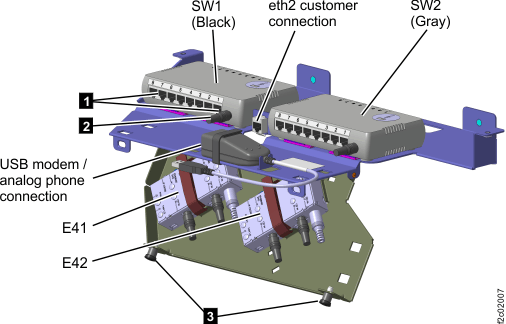
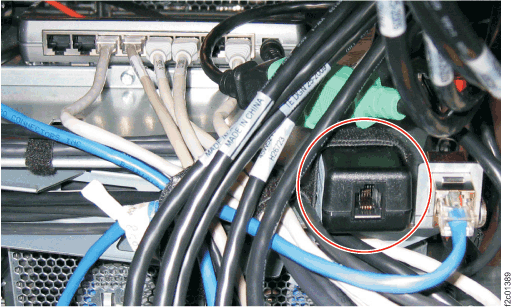
unit USB modem is at the rear of the rack, at the rear of the Ethernet switch tray.
Procedure
Unfasten the USB modem from the sheet metal bracket. It
is held in place with a hook-and-loop fastener.
Figure 1. USB modem at rear of rack (right side of tray)
Figure 2. Customer modem
and Ethernet connectors, DS8870 All Flash, rear of rack
Disconnect the USB modem integrated short USB cable.
The USB modem integrated short USB cable is routed down
and into the laptop tray
cable management arm. It connects to a USB cable that goes to the laptop at the
front of the rack.
Remove the USB modem from the rack.
Install the USB modem
Procedure
Install the new USB modem.
Set the USB modem into the mounting bracket and secure
it with the hook-and-loop fastener.
Route the USB modem-integrated USB cable down to the laptop tray
cable management arm.
Connect the USB modem-integrated USB cable to the USB
cable in the laptop tray
cable management arm.
Ensure that there is some slack in the cable to ensure
it stays connected when the cable management arm moves when the laptop tray
is moved in and out.
Test the laptop unit
to ensure that the modem is functioning:
If the customer allows a phone line connection, test
the modem. Select Service Management > Manage Outbound Connectivity > Configure > Local Model > Test.