DS8000 Service Documentation Version 7.5

Installing and testing the Rack-2 I/O enclosures host adapter cards

Procedure

  1. Does Rack-2 contain I/O enclosure host adapter cards?
  2. In the left navigation pane, click Storage Facility Management.
  3. Select the storage facility that contains the Rack-2 host adapters being installed.
  4. In the right pane lower task area, click MES Install/Remove > Install I/O Enclosures or Components.
  5. When the "Were you sent here from the MES or installation instructions" screen is displayed, click Yes.
  6. In the Single Choice Message Box, click Install Host Adapter, then Submit.
  7. In the next Single Choice Message Box, click the SFI that the host adapters will be assigned to, then click Submit.
    Figure 1. Location codes for device adapter and host adapter cards
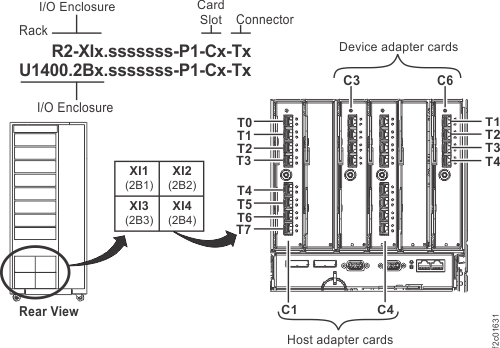
    Location codes for device adapter and host adapter cards
  8. In the Action Panel, select all Rack-2 I/O enclosures (drawers) containing host adapters to be installed. Valid host adapter locations would be slots C1, C4. See Figure 1 for locations. To select multiple enclosures, hold the control key and click the enclosure(s). Click Submit.
    Note: Do not select I/O enclosures which do not contain host adapters to be installed.
  9. In the Select Empty Slots window, select all the slots that already contain host adapters to be installed. When all slots containing host adapters have been selected, click OK.
  10. A series of windows will be displayed, including:
    • Deactivating application(s)
    • Deactivating the system
    • Powering off FRU(s)
  11. The InsMESInstructions window will direct you to return to the installation instructions to install the host adapter to location U1400.xBx.ssssss.Px.Cx. Host adapters are already mechanically installed in the slots indicated in each window. For each window, confirm the host adapter is securely installed in the slot specified in the window, then click Next to continue to the next adapter. After clicking next on the last adapter to be installed, proceed to the next step.
  12. A series of windows will be displayed, including:
    • Powering on FRU(s)
    • Waiting 3 minutes for the system to log errors
  13. The ConfirmWrapTestBean window opens and asks if you would like to perform a wrap test on adapter U1400.rBn.sssssss-P1-Cx. It is strongly recommended you perform the wrap tests at this time. The tests can be run on multiple ports at once, and require one wrap tool per port.
    1. To defer the wrap test, click No. You are presented with the same window for each adapter to be installed. Click No for each, then proceed to step 20.
    2. To continue with the wrap test on the adapter shown, click Yes.
  14. In the Perform a Wrap Test on Host Ports window, select the port(s) to test. Make note of the port locations selected, as you will be inserting a wrap tool in each port in the next step. Click Start Wrap Test.
  15. In the Start Wrap Test window, read the directions. After the wrap tool is inserted in each port to be tested, click Start.
  16. A status window opens that displays the wrap test is in progress.
  17. When the wrap test for the selected adapter completes, a window opens that displays each port and the result on that port. If additional ports will be tested on the same host adapter, repeat steps 12 through 14 for these additional ports. Once all tests are complete on this adapter, click Finish.
  18. The Wrap Test Complete window opens. Remove the test tool(s) and click Next.
  19. If an additional host adapter remains to be tested, the ConfirmWrapTestBean window opens for that adapter. Repeat steps 12 through 16 for each additional host adapter.
  20. A series of windows will be displayed, including:
    • Activating Applications
    • Verifying Applications
    • Waiting 3 minutes for the system to log errors
  21. The ServiceActionCompleteForInstallPanelBean window opens and indicates that the installation is complete. Do not click Next. Customer host cables can be routed at this time.
    Note: Fibre-Channel or FICON cables must have been ordered and received separately by the customer before the following steps can be performed. If the cables are not currently available, you may defer the routing of host cables and continue to step 25.
  22. Does the rack have overhead cable management (top exit) for host and data cables?
    • Yes, go to step 24.
    • No, go to step 23.
  23. Open the tailgate and route the host cables.
    1. In the tailgate, squeeze the black release levers Callout label 2, pivot the retention bracket up and then remove it.
      Figure 2. Tailgate cable and Fibre Channel cable retention (Model 95x shown, Model 96x is similar)
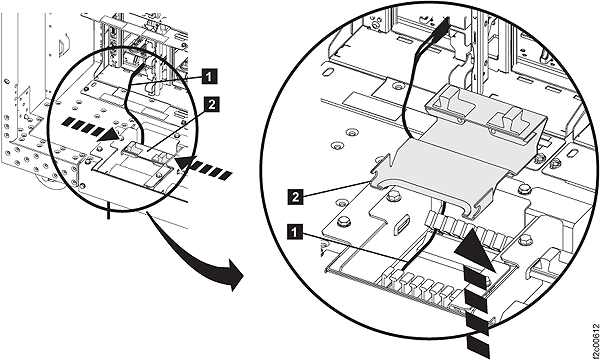
      Tailgate cable clamping and fibre channel cable retention hardware
    2. Feed the host cables Callout label 1 up through the tailgate and route them to the destination I/O enclosure and host card adapter ports, and then plug them in.
    3. Secure the host cables in the cable guide by pressing them into the slots.
    4. After you route and connect the host cables, continue to step 25.
      Attention: Host adapter ports display as offline until the topology is set by the customer.
  24. Open the top tailgate and route the host cables.
    1. Unfasten the top tailgate retention bracket, and rotate it open. See Figure 3.
      Figure 3. Top tailgate
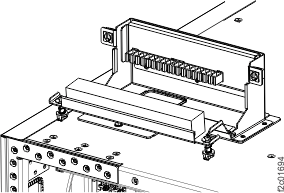
      Top tailgate
    2. Feed the host cables Callout label 1 down through the top tailgate. Carefully route the cables through the channel in the left rear of the rack, across to the destination I/O enclosure and host card adapter ports, and then plug them in. See Figure 4.
      Figure 4. Overhead cable management (top exit) for Fibre Channel, communication, and power cables
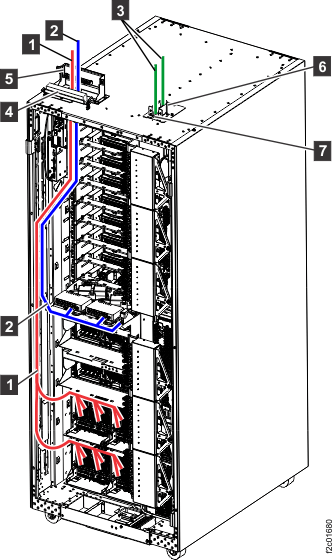
      Overhead cable management (top exit) for Fibre Channel, communication, and power cables
    3. Leave some slack in the host cables between the host adapter cards and the tailgate. Secure the host cables in the tailgate cable retention slots.
    4. After you route and connect the host cables, rotate the top tailgate retention bracket closed, and fasten it. See Figure 3.
    5. Continue to step 25.
      Attention: Host adapter ports display as offline until the topology is set by the customer.
  25. In the ServiceActionCompleteForInstallPanelBean window, click Next and continue with the next section.